What you actually see inside the Vasari Corridor
The bareness is the point
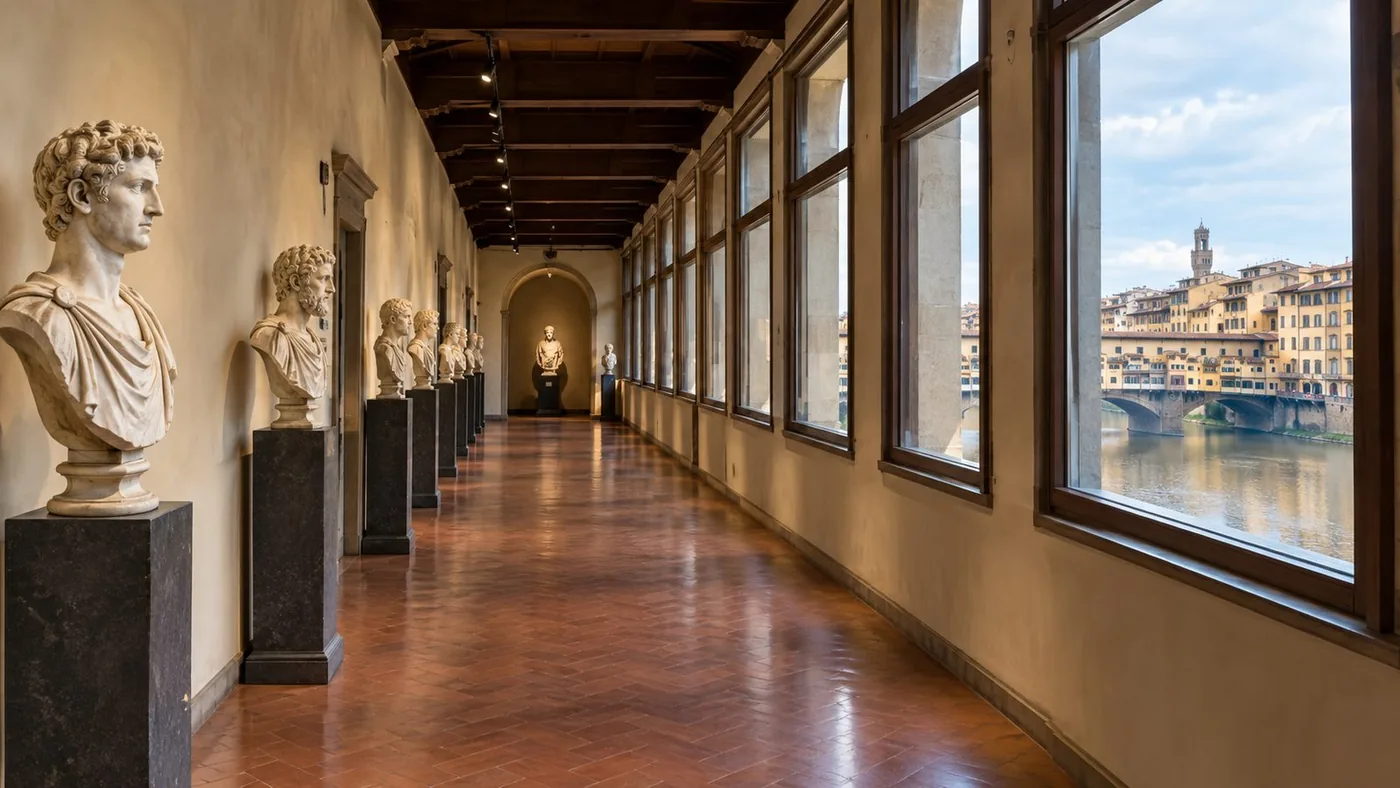
The museum did not run out of money for hanging things. It describes the restored corridor as an air tunnel and treats the emptiness as the restoration’s result rather than its compromise: LED lighting, video monitoring, five emergency exits, toilets at the end. Groups are capped at twenty-five people plus two staff. What that produces is unusual in central Florence, which is a large interior with nobody standing still in it. The floor runs on ahead of you and the light arrives from both sides at once.
The windows over the Ponte Vecchio
This is the stretch people book for. The corridor runs along the top of the bridge, above the goldsmiths, and the windows put the river on your left and your right at the same time. The shops beneath you exist because of the corridor: the Medici had the butchers moved off the bridge so the smell would not reach the passage, and goldsmiths were established in their place by 1593. They have not left. The full account of why any of it was built is in the complete guide.
Fifty Roman heads
In July 2025 the Uffizi installed more than fifty Roman marble portrait busts along the stretch above the bridge, on dark marble pedestals. Cicero is there, and the emperor Augustus, Antoninus Pius, and the empresses Faustina and Sabina. Many were bought on the eighteenth-century antiquities market by Luigi Lanzi, a former deputy director of the gallery, and they had been in storage since 1993. On 27 May 1993 a Mafia car bomb in Via dei Georgofili, immediately beside the Uffizi, killed five people, two of them children, and damaged the gallery and the corridor. The busts went into store that year and came back out thirty-two years later.
The tower that did not move
At the southern end of the bridge the corridor stops running straight and swings out around the medieval Torre dei Mannelli on stone brackets. The Mannelli family refused to let their tower be demolished for the Medici’s convenience, so the passage was carried around its western face instead. It is still there, and it is the one place on the route where a private family said no to a Grand Duke and won.
The balcony above Santa Felicita
Past the tower the corridor crosses the façade of the church of Santa Felicita, where a balcony behind a heavy railing looks down into the interior. The ruling family could hear mass without being in the congregation, which is the whole logic of the corridor compressed into one small opening: present, elevated, separate.
Where the self-portraits went
Into the gallery. Since 2023 the collection has twelve permanent rooms on the Uffizi’s first floor, painted pink and hung chronologically, showing 255 works chosen from more than two thousand. It is described as the largest and oldest collection of self-portraits in the world, and you pass it on the same ticket that takes you into the corridor. What else deserves planning around is on the Uffizi highlights route, and our honest read on whether the bare version rewards the ticket is on is it worth it.
Frequently asked questions
How long is the Vasari Corridor?
The Uffizi Galleries describe it as more than seven hundred metres long over the heart of the city, and it is commonly rounded to about 750 metres. Some sources say roughly a kilometre; we would use the museum’s own figure. What that means for your feet is on how long it takes.
Are there any paintings in the Vasari Corridor now?
No paintings. Since July 2025 there are more than fifty Roman marble portrait busts along the stretch above the Ponte Vecchio, and otherwise the passage is deliberately bare. The pictures that used to hang here are inside the gallery.
Can you really look down into a church from the corridor?
Yes. The passage crosses above the façade of Santa Felicita and there is a balcony, behind a heavy railing, overlooking the church interior. It was built so the Grand Duke’s family could attend mass without joining the congregation.
Can you walk the corridor in both directions?
No. It is walked one way, entering from Room D19 on the Uffizi’s first floor and leaving by the door beside the Buontalenti Grotto in the Boboli Gardens. Every product on our tour list works that way, because the museum sets the route.