The Vasari Corridor, explained
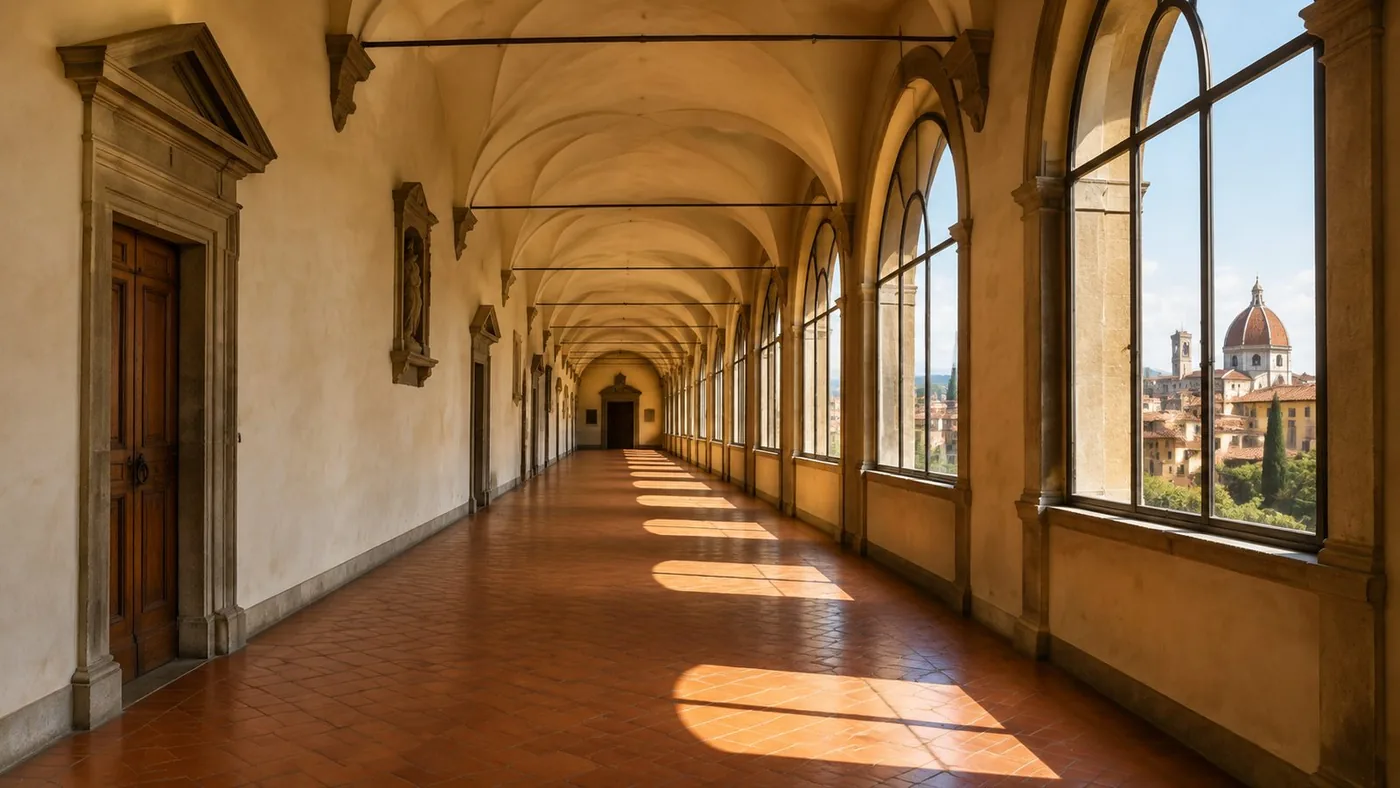
The Vasari Corridor is a covered passage of more than seven hundred metres that Giorgio Vasari built for Cosimo I de’ Medici in 1565, running from the Uffizi across the top of the Ponte Vecchio and through the Oltrarno to the Boboli Gardens. It let the ruling family cross their own city without entering its streets. It closed in 2016, reopened on 21 December 2024 stripped back to bare architecture, and is walked one way by timed slot.
This page is the long version. If you want the short one, start with what you actually see inside, then whether it is worth booking.
Almost everything written about the Vasari Corridor online describes a place that no longer exists: a cramped tunnel hung with self-portraits, seen on a rare private visit. That version ended in 2016. What reopened on 21 December 2024 is the building itself, emptied out. Here is the passage as it now stands, and how it got that way.
Why a ruler builds a private road
In 1565 Cosimo I de’ Medici governed Florence from Palazzo Vecchio and lived across the river in Palazzo Pitti, and between the two lay the city he governed. The corridor solved that. It runs from the south side of Palazzo Vecchio, through the Uffizi, over the Arno along the top of the Ponte Vecchio, through the Oltrarno and into the Pitti beside the Boboli Gardens, and at no point does it touch a street. The Uffizi Galleries put its length at more than seven hundred metres over the heart of the city; you will see “about a kilometre” elsewhere, and we would take the museum’s own figure. Safety was one reason. Distance from the governed was the other.
Five months, and a wedding to be ready for
Giorgio Vasari — the painter and architect who wrote Lives of the Artists, and who had already raised the Uffizi next door as offices for the Florentine magistracies — took the commission in 1564 and finished in about five months. The deadline was the marriage of Cosimo’s son Francesco to Joanna of Austria. Five months for a covered road across a river and a working bridge is a startling pace, and it shows: this is a road built to get somewhere rather than to be admired.
The house that said no
The route wanted a straight line and the Mannelli family owned a medieval tower standing in it. They refused to have it demolished, so the corridor was carried around the tower’s western face on stone brackets, and the detour is still there to walk through. It is the one place on the passage where a private family said no to the Medici and won.
A balcony over a church, and butchers off a bridge
Further along, the passage crosses above the façade of Santa Felicita and opens onto a balcony behind a heavy railing, looking down into the church interior. The Grand Duke’s family could hear mass from up there without ever being in the congregation, which says as much about sixteenth-century rule as any painting in the gallery. The Ponte Vecchio got a similar treatment: its butchers were moved off the bridge so the smell would not reach the passage above, and goldsmiths were established there by 1593 and still trade under the same windows. There is more of this on what you actually see inside.
The self-portrait years, and why they ended
From 1973 to 2016 the corridor was where the Uffizi hung its self-portrait collection, and that is the version most guidebooks still describe. The museum’s own account is blunt: the space lacked air conditioning and adequate lighting, and the paintings could only be seen on restricted, occasional visits. Since 2023 the collection has had a proper home — twelve rooms on the Uffizi’s first floor, painted pink and hung chronologically, showing a selection of 255 works from a holding of more than 2,000, described as the largest and oldest collection of self-portraits in the world. If those pictures were your reason for booking, book the gallery instead and see them where they hang now.
27 May 1993
A Mafia car bomb exploded in Via dei Georgofili, immediately beside the Uffizi. Five people were killed, two of them children, and the gallery and the corridor were damaged. Many of the Roman busts now standing in the passage had been in storage since that year. We mention it because it is part of why the building looks as it does, and for no other reason.
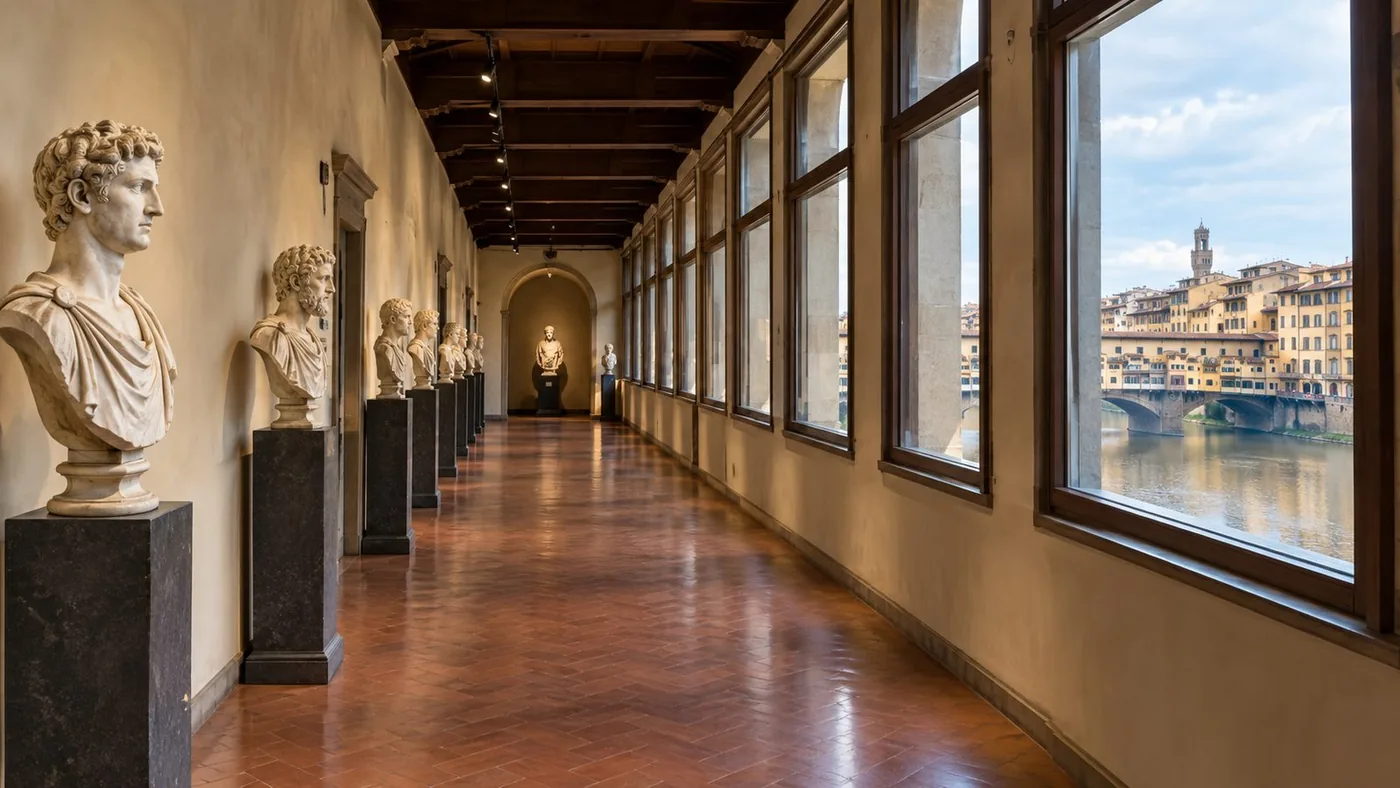
What “original bareness” means when you are standing in it
The corridor closed in 2016 to be brought up to modern safety standards and reopened on 21 December 2024, after a restoration reported to have cost around €10 million, with a further million-dollar donation from the American entrepreneur Skip Avansino in 2023. The museum restored it to what it calls its original bareness and describes it as an air tunnel. In practical terms: LED lighting, video monitoring, five emergency exits, toilets at the end, ramps, platforms and lifts, and groups capped at twenty-five people plus two staff. You enter from Room D19 on the gallery’s first floor and leave by a door beside the Grotta del Buontalenti in the Boboli Gardens, one way only. In July 2025 the Uffizi installed more than fifty Roman marble portrait busts on dark pedestals along the stretch above the Ponte Vecchio — Cicero, Augustus, Antoninus Pius, the empresses Faustina and Sabina among them, most bought on the eighteenth-century antiquities market by Luigi Lanzi, a former deputy director of the gallery. Fifty Roman faces and a row of windows over the river is, near enough, the content of the walk.
Who should book it
Book it if the appeal is the walk: a private elevated road built for one family, over a working bridge, with the Arno on both sides and the emperors watching. Book a guided option if you want the building read to you, since bare architecture gives an interpreter more to do than a wall of labelled paintings ever did; the case for that sits on private and small-group tours. Skip it if you were coming for pictures hung in a corridor, and spend a longer morning in the gallery instead. Our honest verdict goes further into who ends up disappointed, and all six booking options sit in one place. The slot is timed and the reservation is mandatory, so it is the part of a Florence trip to fix first.
Ready to book?
Corridor slots are sold as part of a combined Uffizi booking, and the live prices and dates sit on GetYourGuide rather than here. Compare the six ways in, or check what is open below.
Frequently asked questions
Who built the Vasari Corridor and why?
Giorgio Vasari built it in 1565 for Cosimo I de’ Medici, so the ruling family could move between Palazzo Vecchio and Palazzo Pitti without going through the streets. It was commissioned in 1564 and finished in roughly five months, in time for the wedding of Francesco de’ Medici and Joanna of Austria. What survives of it today is the architecture rather than the decoration.
Are the self-portraits still hanging in the corridor?
No. They hung there from 1973 to 2016, and that is the version most older articles describe. Since 2023 the collection has had twelve permanent rooms on the Uffizi’s first floor. The corridor itself was restored to what the museum calls its original bareness. If the paintings were your reason for going, read our honest verdict first.
How do I book the corridor?
Only as part of a combined Uffizi booking, on a timed slot, and reservation is mandatory. You can take it as a plain reserved ticket, with an audio app, on a small-group guided tour, or privately — the six options are compared here, and what drives the price is explained here.